
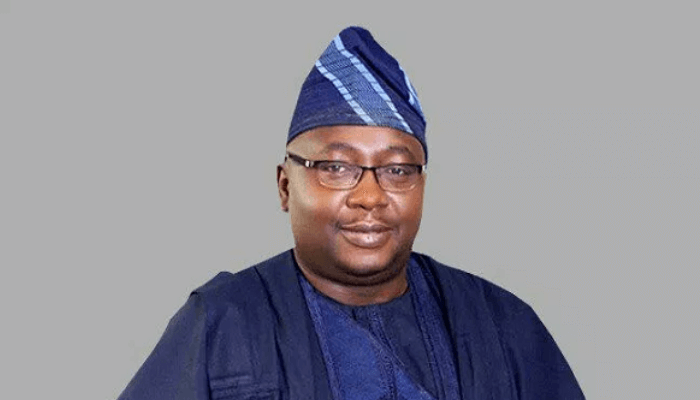
By Ọlabọde Adekanye
In Ọ̀yọ́ State, politics speaks Yoruba before it speaks English. When the people truly want you, they say Ọ̀yọ́ ń pè ọ́—Ọ̀yọ́ is calling you. When they want to ruin you with a fulsome smile, they say Ọ̀yọ́ ń tàn ọ́—Ọ̀yọ́ is deceiving you, a calculated deception masked as support. Chief Adebayo Adelabu today qualifies for neither. He has managed the rare feat of earning neither trust nor trickery. After his tenure as Minister of Power, he stands politically orphaned in his own home.

Every political culture has its shibboleths. In Ọ̀yọ́, those shibboleths decide who rises and who is quietly buried. Ọ̀yọ́ ń pè ọ́ is not mere flattery; it is a social contract. It signals that market women, artisans, clerics, and kingmakers have weighed a man and found him weighty. Ọ̀yọ́ ń tàn ọ́, by contrast, is the velvet dagger—the applause that empties a war chest and the crowd that vanishes on election day. It is how Ọ̀yọ́ tells a man to spend himself into irrelevance.
Adelabu, fresh from his stint as Minister of Power, commands neither contract nor dagger. He is, in the brutal arithmetic of Ọ̀yọ́ politics, standing right at the edge of the precipice.
To understand why, one must revisit the power ministry, not as a bureaucratic office but as a moral theatre where leadership is measured in outcomes.
Nigerians do not ask for miracles from that office. They ask for the modest dignity of few hours of uninterrupted electricity. Yet, according to data from the World Bank, Nigeria’s per capita electricity consumption remains among the lowest globally—less than 150 kWh per year, compared to a global average of over 3,500 kWh. The national grid, despite an installed capacity exceeding 13,000 MW, continues to struggle with sustained delivery.
Since Adebayo Adelabu assumed office in August 2023, Nigeria’s national grid has continued to experience repeated instability. Between 2024 and early 2026, the system reportedly suffered about 25 to 27 collapses, based on a combination of official remarks and independent monitoring reports. Most of these disruptions were recorded in 2024 and 2025, with only limited improvement evident in early 2026. The pattern reflects ongoing structural weaknesses in the power sector, despite stated reform efforts aimed at improving grid reliability.
Under Adelabu, the promise of reform collided repeatedly with the reality of fragility. The grid did not merely underperform; it misbehaved with a predictable unpredictability. System collapses became almost cyclical, reinforcing an old national anxiety—that the slightest pressure is enough to bring the entire structure down. At the same time, tariff adjustments advanced under the banner of “cost-reflective pricing,” rising faster than any measurable improvement in supply, leaving citizens to pay more for less illumination. The ministry that should illuminate homes became, in effect, a case study in how to darken national hope.
Technocrats warned. Engineers groaned. Citizens adapted with generators, inverters, solar improvisations, and a quiet resignation that borders on despair. Nigeria now has one of the highest rates of self-generation in the world, with businesses and households collectively spending billions of dollars annually on diesel and petrol to compensate for grid failure, according to estimates from international energy assessments. By the time he left, the only thing he had powered consistently was public anger.
That record travelled home. In Ibadan, where memory is long and patience is short, people keep score. The pepper seller at Oje knows when her cold room failed. The welder at Mokola knows when he lost contracts. The student at The Polytechnic Ibadan knows when night reading became a luxury rather than a routine. These are not abstract policy failures; they are personal betrayals. And Ọ̀yọ́ people, for all their famed hospitality, do not reward betrayal with power.
So Adelabu returns to seek office. On what platform? On what goodwill? The same goodwill he burned through like diesel in a government generator?
He has no moral capital left to spend. No performance record to point to. No civic ledger where he is not already overdrawn.
Yet he will run. Of course, he will. Because the defining pathology of the average Nigerian politician is a boundless capacity for self-exoneration. Indictment becomes an inconvenience. Failure becomes footnotes. They read their own press releases and believe them. They mistake motion for progress and noise for mandate.
Adelabu, by all indications, suffers from this affliction. He will file papers, hire praise singers, and act as if the Ministry of Power was a minor misunderstanding between him and history. But history keeps receipts. And Ọ̀yọ́ keeps scorecards.
The greater danger is not that Adelabu will run. The danger is that we forget why he should not. That we normalise incompetence because it wears an agbádá. That we confuse shamelessness with resilience. That we allow the vocabulary of “unprecedented” to conceal the reality of “unproductive.”
Political memory, in fragile democracies, is notoriously short. Yet, accountability demands continuity of memory. Without it, failure recycles itself as ambition, and mediocrity returns dressed as experience.
Ọ̀yọ́ has a word for leaders it trusts: Ọ̀yọ́ ń pè ọ́. It has a word for leaders it intends to disgrace: Ọ̀yọ́ ń tàn ọ́. For Adelabu, there is currently silence. And in politics, silence is the loudest verdict. It signals a more devastating judgement than opposition—it signals irrelevance. It means you have become so politically weightless that you are not even worth deceiving.
A man’s record is the only godfather that cannot be bribed. Whatever Adelabu thinks of himself, whatever posters he prints, whatever crowds he rents, his scorecard will follow him like a shadow. In Ọ̀yọ́, they call that an albatross. In the rest of Nigeria, we call it a consequence. And consequence, unlike the grid, never collapses.
Leave a Reply