
…As 178 LGAs in 32 states risk devastating flooding in 2023
SHARE THIS

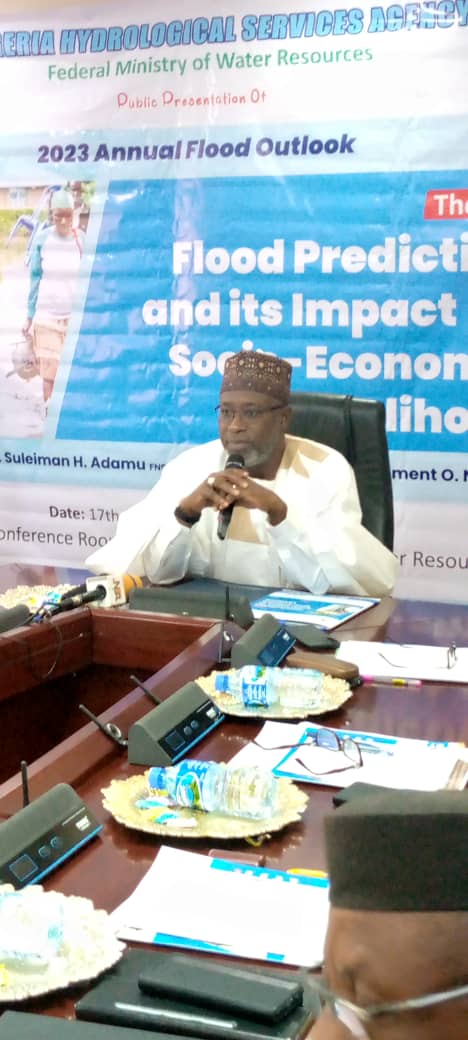
- Pix(above): Hon. Minister of Water Resources, Engr Suleiman H. Adamu, presenting the Nigeria Hydrological Services Agency 2023 Annual Flood Outlook (AFO)
“Flood can have devastating consequences and there is need for necessary measures to be taken, to mitigate the impact of these natural disasters and the importance of accurate flood forecasting in protecting the lives and properties of our citizens cannot be overstated”. This statement was made by the Hon. Minister of Water Resources, Engr. Suleiman H. Adamu, at the 8th edition of the Presentation of the 2023 Annual Flood Outlook (AFO) by The Nigeria Hydrological Services Agency (NIHSA) in Abuja on 17th February, 2023.
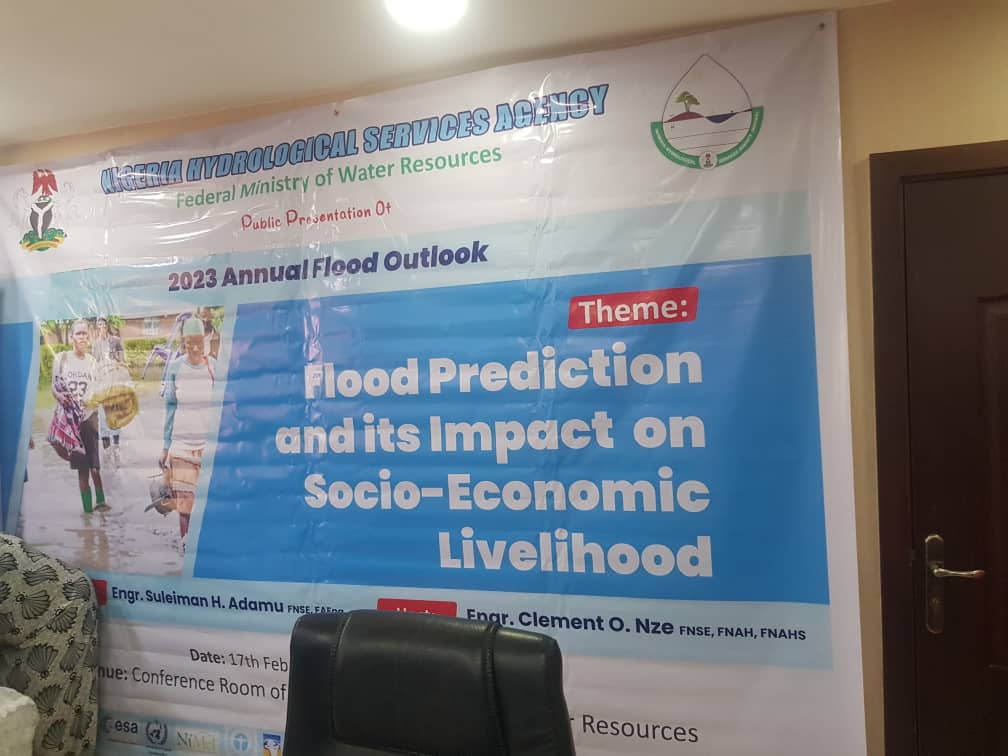
Speaking during the event, Adamu said that the theme of this year’s event – “Flood Prediction and its impact on Socio-Economic Livelihood”, aligns with the Goal 1 of the United Nations Agenda For Sustainable Development (SDGs) which is targeted at building the resilience of the poor, those in vulnerable situations, and reducing their exposure as well as their vulnerability to climate related extreme disasters, which has adverse effect, economically, socially and environmentally.
Essentially, the Minister revealed that 178 LGAs in 32 states, including FCT, risk devastating flooding in 2023, prompting the urgent need for precautionary measures.
He said: “The forecasts for 2023 AFO shows that 178 local councils in 32 states of the federation and the FCT fall within the Highly Probable Flood Risk Areas, while 224 local councils in 35 states of the federation, including the FCT, fall within the Moderately Probable Flood Risk Areas. The remaining 402 local councils fall within the Probable Flood Risk Areas. The Highly Probable Flood Risk States are Adamawa, Abia, Akwa Ibom, Anambra, Bauchi, Bayelsa, Benue, Cross River, Delta, Ebonyi, Ekiti, Edo, Gombe, Imo, Jigawa, Kaduna, Kano, Kebbi, Kogi, Kwara, Lagos, Nasarawa, Niger, Ogun, Ondo, Osun, Oyo, Rivers, Sokoto, Taraba, Yobe, Zamfara and the FCT.
“Highly Probable Flood Risk Areas between the months of April and November, in 2023 the level of floods in this category is expected to be high in terms of impact on the population, agriculture, livelihood, livestock and infrastructure, and the environment. Part of 66 local councils across the country fall within the Highly Probable Risk areas in the months of April, May and June, while part of 148 local councils in the months of July, August and September, and part of 100 local councils in the months of October and November, 2023. The details of the councils and their corresponding states are contained in the publication
Probable Flood Risk Areas between the months of April and November, 2023, the moderate impact level of floods are expected in parts of 41 local councils within the months of April, May and June, and in parts of 199 local councils within the months of July, August and September, and parts of 73 local councils within the months of October and November, 2023.
“Bayelsa, Cross River, Delta, Edo, Lagos, Ogun, Rivers and Ondo will be experiencing coastal flooding due to rise in sea level and tidal surge which would impact on fishing, wildlife habitation and river navigation.
Flash and urban flood will be experienced in urban cities centres across the country. Among these cities are Lagos, Kaduna, Suleja, Gombe, Yola, Makurdi, Abuja, Lafia, Asaba, Port Harcourt, Yenagoa, Ibadan, Abeokuta, Benin City, Bimin- Kebbi, Sokoto, Lakoja, Maiduguri, Kano, Oshogbo, Ado-Ekiti, Abakaliki, Awka, Nsukka, Calabar, Owerri.
He noted that Nigeria, just like the rest of the world, have suffered from the devastating effects of flood from varying degrees of severity.
“2022 flood is the worst recorded flooding incident in the country in terms of impact. The World Bank estimated the economic damage to residential and non- residential buildings, infrastructure, productive sector, and farmlands at $6.68 billion dollars.”
Adamu recalled that the inauguration of the Presidential Committee for the Development of Action Plan on 3rd November, 2022 was Mr. President’s directive and a concerted effort to curtail the recurrence of devastating flood disaster in Nigeria.
While applauding NEWMAP, AAH, NEMA, NESDRA, NIMET, private organizations and other collaborating NGOs for their partnership and unflinching support , the Minister said, “this 2023 Annual Flood Outlook(AFO) is therefore coming at the right time as it will serve as a valuable resource towards enriching the work of the Presidential Committee on Flood.
“It is also aimed at detailing information on the probable flood risk areas in 2023 with their degree of vulnerability,” the Hon Minister stated.
Earlier, the Permanent Secretary, Mrs Didi Esther Walson-Jack, MCIPM, mni, ably represented by the Director, River Basin Operations and Inspectorate, Mr. John Ochigbo, had revealed that the overall objective of this event is to sensitize the populace on the need to embark on the preventive measures which are necessary to improve the safety of lives, reduce potential damages to property and infrastructure that has been witnessed from the recent flood disasters particularly, that of 2022.
While hinting that over 1.4million people were displaced, 662 people reported dead, coupled with economic devastations caused by the 2022 flood, with the 2023 Annual Flood Forecast, the Permanent Secretary said, “the negative impact of flood will be on the decline by promoting better understanding of flood risks and ensuring that mitigating measures are deployed appropriately.”
Goodwill messages were presented at the event by Director-General of NIMET, Director General of NIRSAL, DG NEMA, DG FEMA, and DG NOA.
In his vote of thanks, the Director General of Nigeria Hydrological Services Agency, Engr. Clement Nze, said that this year’s Annual Flood Outlook publication serves as a measure to sensitize the populace and create awareness on the inherent dangers of flooding in order to minimize its negative impact./SHARE THIS
Leave a Reply