
By Wole Adedeji, Ilorin
Professor Peter Okebukola, former Executive Secretary of the National Universities Commission (NUC) has advised the Commission to develop an accreditation framework to cater for the emerging technology programmes

Such programmes he said, recognise rapid evolution of fields which allows for more flexibility in the 30 per cent institutional additions to the CCMAS.
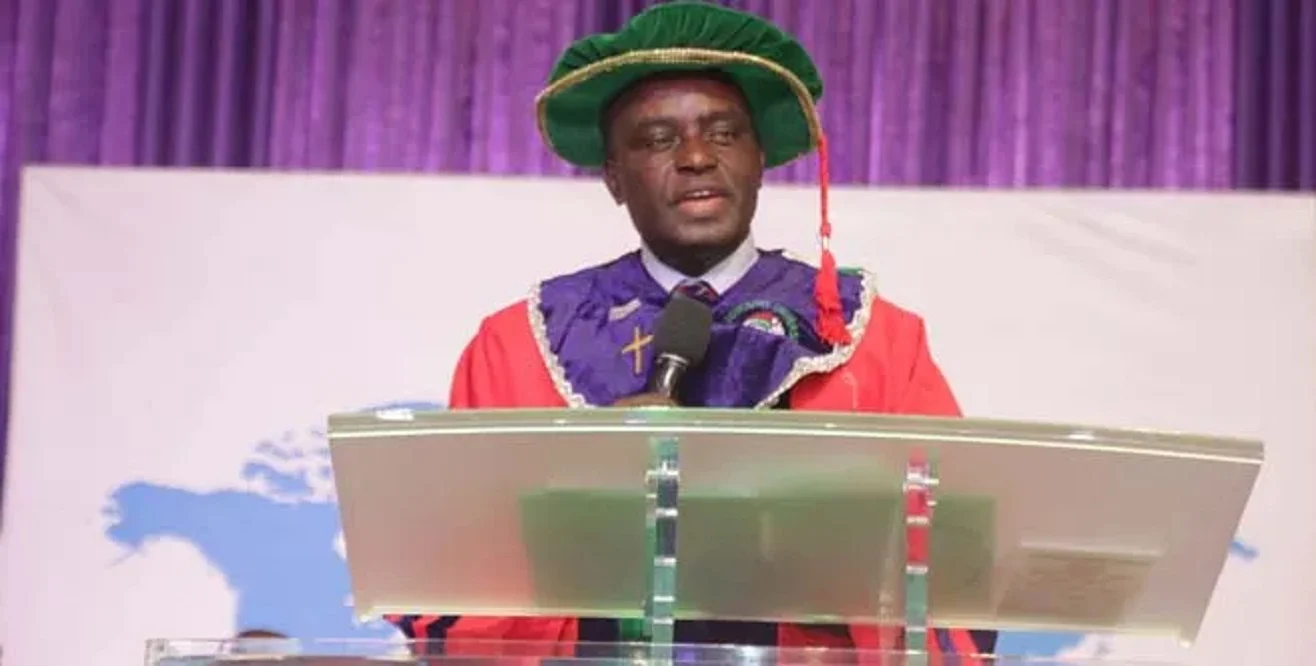
The former NUC Scribe made this suggestion while delivering the 13th Convocation Lecture of the Kwara State University (KWASU) titled ‘Universities In The Age of Quantum; Thinking Redefining Quality, Relevance And Innovations Through Emerging Technology.’
He said joint collaboration of NUC with the TETFund to establish a National Quantum and AI Education Fund that provides competitive grants to universities would demonstrate commitment to these areas, focusing on preparing a workforce capable of using the latest quantum computing technologies for scientific discovery.
He also recommended for federal and state governments, a dramatic increase in research and development funding for universities, regretting that: “currently, Nigeria invests approximately 0.2 per cent of Gross Domestic Products (GDP) in research, far below the African average of 0.5 per cent which also is well below the global leaders who invest 3 to 4 per cent.
His words; “Government should establish tax incentives for private sector organisations that fund university research or establish research chairs in emerging technology areas” .
He added that they should also building on the NUC’s 2025 partnership with France’s AFD on a 38 million euro ICT transformation project for Nigerian universities adding that government should actively seek additional international partnerships that bring both funding and expertise to our institutions.
“Government should mandate that a percentage of all technology procurement contracts include capacity-building components that involve Nigerian universities, ensuring that we build local expertise rather than remaining perpetually dependent on foreign knowledge,” he said.
Also talking to the private sector and development partners, Professor Okebukola recommended the strengthening of industry-university collaboration hubs in every geopolitical zone, where he said companies could pose real-world problems and that universities could propose research-based solutions, with successful projects leading to commercialisation opportunities.
He also suggested to the Private sector to prioritise funding for digital infrastructure in universities, recognising that participation in the quantum age requires reliable internet connectivity, and adequate computing power.
The former NUC Scribe also advised Nigerian Universities to establish a Quantum Futures Institute (QFI) that would serve as an interdisciplinary hub for exploring emerging technologies and their applications.
He charged the management of Universities to keep their minds open to many possibilities; think creatively before choosing; see connections between different ideas; and be flexible to changes and ideas.
He said: “Quantum thinking is not merely a metaphorical flourish. It is a necessary cognitive framework for institutions operating in an era where nearly one billion jobs worldwide will undergo significant changes due to technology within the next decade.”
Earlier, at the Pre-Convocation press briefing on Tuesday, the Vice Chancellor, Professor Shaykh-Luqman Alade Jimoh, said the University is now listed as one of the pilot institutions of the Presidential Initiatives on Compressed Natural Gas (PICNG).
With this feat he said, KWASU had established 2 CNG Conversion Centres rendering services to the people while the institution by virtue of being listed would be receiving CNG buses and tricycles to improve mass transit services in the area.
The Vice Chancellor also disclosed that the State Government is already patronising the institution’s vehicles conversion services to bring up its grounded vehicles which had been handed over to Kwara Ministry of Business, Innovation and Technology.
The Varsity Engineers he concluded had fabricated a prototype electric vehicle from the scratch as an advanced stride towards converting from petrol to electric vehicles.
Leave a Reply