
SHARE THIS
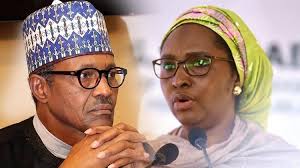
–|Pix(above, L-R): PMB and Zainab Ahmed, HMF

As many as 133 million Nigerians out of the estimated 218,241,745 are multi-dimensionally poor, the National Bureau of Statistics (NBS) has lamented.
Making the lamentation in its 2022 Multidimensional Poverty Index (MPI) survey released in Abuja on Thursday, November 17, 2022, the bureau said the figure represents 63 percent of the nation’s population, adding that the poverty index is mostly experienced in rural areas, especially in the north, with women and children being worst hit.

The MPI offers a multivariate form of poverty assessment, identifying deprivations across health, education, living standards, work and shocks.
According to Statistician-General of the Federation, Semiu Adeniran, this is the first time the NBS will be conducting a standard multi-dimensional poverty survey in Nigeria, noting that the survey was implemented in 2021 to 2022, and it is the largest survey with a sample size of over 56,610 people in 109 senatorial districts in the 36 states of Nigeria.
The United Nations Resident and Humanitarian Coordinator in Nigeria, Matthias Schmale, revealing the findings from the report, said 63 per cent of Nigerians are multi-dimensionally poor, “meaning that they are being derived in more than one dimension of the four measured.”
According to him, “Multi-dimensional poverty is more pronounced in rural areas where 72 per cent of people are poor compared to urban areas where we have 42 per cent.
“Gender disparity continues to affect the population with one in seven poor people living in a household in which a man has completed high school but the woman has not.”
The current population of Nigeria is 218,241,745 as of Wednesday, November 16, 2022, based on Worldometer elaboration of the latest United Nations data./SHARE THIS
- Tags: NBS, MPI, Semiu Adeniran, Matthias Schmale, FGN, Festering poverty
Leave a Reply