

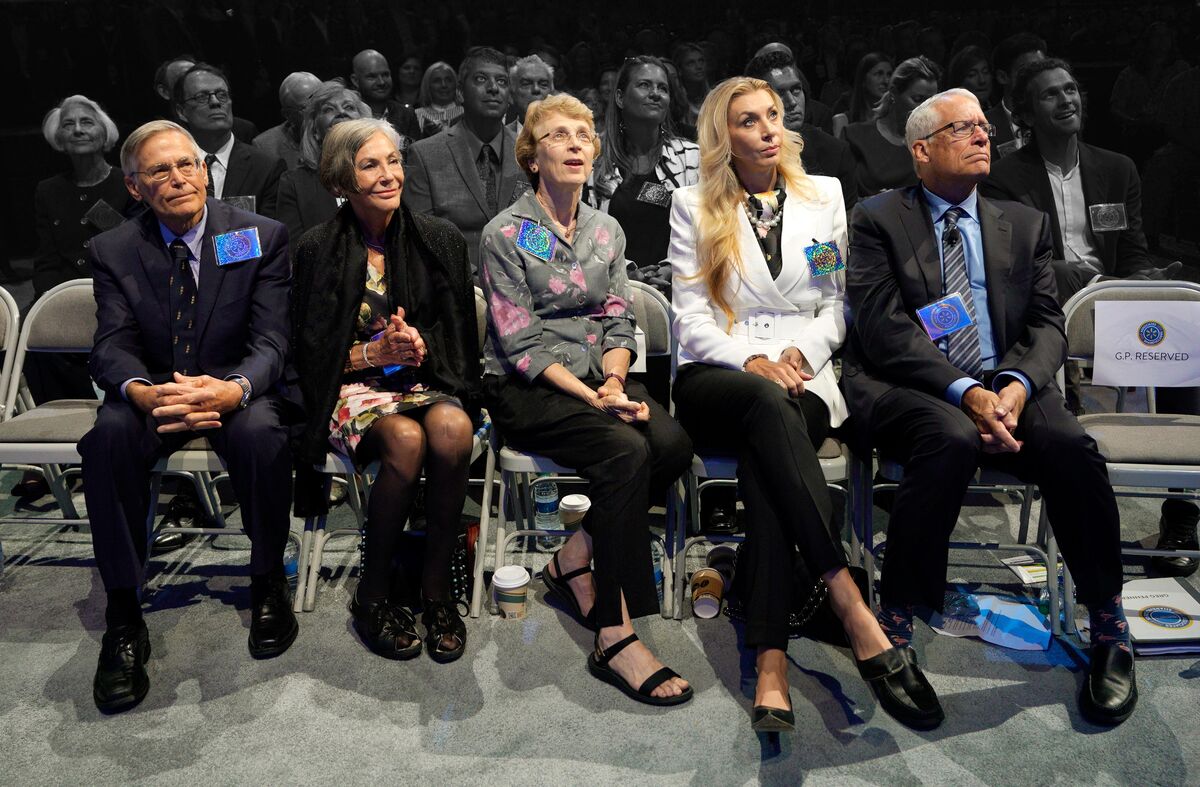
The 25 wealthiest dynasties on the planet control $1.4 trillion
The numbers are mind-boggling: $70,000 per minute, $4 million per hour, $100 million per day.

That’s how quickly the fortune of the Waltons, the clan behind Walmart Inc., has been growing since last year’s Bloomberg ranking of the world’s richest families.
At that rate, their wealth would’ve expanded about $23,000 since you began reading this. A new Walmart associate in the U.S. would’ve made about 6 cents in that time, on the way to an $11 hourly minimum.
Even in this era of extreme wealth and brutal inequality, the contrast is jarring. The heirs of Sam Walton, Walmart’s notoriously frugal founder, are amassing wealth on a near-unprecedented scale — and they’re hardly alone.
The Walton fortune has swelled by $39 billion, to $191 billion, since topping the June 2018 ranking of the world’s richest families.
So it goes around the globe. America’s richest 0.1% today control more wealth than at any time since 1929, but their counterparts in Asia and Europe are gaining too. Worldwide, the 25 richest families now control almost $1.4 trillion in wealth, up 24% from last year.
To some critics, such figures are evidence that capitalism needs fixing. Inequality has become an explosive political issue, from Paris to Seattle to Hong Kong. But how to shrink the growing gap between the rich and the poor?
As the tension increases, even some billionaire heirs are backing steps such as wealth taxes.
“If we don’t do something like this, what are we doing, just hoarding this wealth in a country that’s falling apart at the seams?” Liesel Pritzker Simmons, whose family ranks 17th on the Bloomberg list, said in June. “That’s not the America we want to live in.”
A notable addition this year: the Saudi royal family.
The House of Saud is worth $100 billion, based on the cumulative payouts royal family members are estimated to have received over the past 50 years from the Royal Diwan, the executive office of the king.
That’s a lowball figure. After all, oil giant Saudi Aramco, the linchpin of the Saudi economy, is the world’s most profitable company. The kingdom is hoping to take it public at a $2 trillion valuation.
Tallying dynastic dollars isn’t an exact science. Fortunes backed by decades and sometimes centuries of assets and dividends can obfuscate the true extent of a family’s holdings. The net worth of the Rothschilds or Rockefellers, for instance, is too diffuse to value. Clans whose wealth is currently unverifiable are also absent.
But of those we can track, most are reaping the rewards of ultra-low interest rates, tax cuts, deregulation and innovation. Koch Industries, for instance, has a venture-capital arm. The latest generation of Waltons is establishing its own enterprises.
Other big gainers include the owners of fashion house Chanel and Italy’s Ferrero family, whose brands include Nutella spread and Tic Tac mints. In India, the fortune of the Ambani family swelled $7 billion, to $50 billion.
In all, the world’s 25 richest families have $250 billion more wealth, compared to last year.
The rich aren’t necessarily getting richer together. The Quandt family dropped eight places following a poor year for Bayerische Motoren Werke AG, which has battled trade tensions and slowing global markets as BMW invests in the disruptive shift to self-driving electric vehicles. The Dassault, Duncan, Lee and Hearst families all fell from the list.
And this could in many ways represent a peak, as U.S. President Donald Trump escalates a trade war with China and worries grow about a global recession.
“It can be very challenging to preserve wealth over the long-term,” said Rebecca Gooch, research director at Campden Wealth, a network and education business for generational-wealth holders. “Family-owned operating businesses can shift from booming to declining, a family’s investment portfolio might not be well diversified or there can be issues with generational transitions.”
UP
 Walmart is the world’s largest retailer by revenue, with sales of $514 billion from more than 11,000 stores worldwide. Family holding company Walton Enterprises owns half the retailer, a stake that’s the foundation of the world’s biggest fortune.
UP
 Frank Mars learned to hand-dip chocolates as a schoolboy. The business he went on to establish is best known for M&Ms and Milky Way and Mars bars, though pet-care products make up about half of the company’s more than $35 billion in revenue. The closely held business is owned by members of the Mars family.
UP
 Brothers Frederick, Charles, David and William inherited father Fred’s oil firm. A fraternal feud over control of the company in the early 1980s led Frederick and William to leave the family business while Charles and David stayed; they have since grown it into Koch Industries, a conglomerate with annual revenue of about $110 billion. David and Charles manage a portion of their wealth through a family office, 1888 Management.
NEW
 The 87 year-old monarchy after which Saudi Arabia is named can credit the nation’s unrivaled oil reserves for seeding its collective fortune. This net worth estimate is based on cumulative payouts royal family members are calculated to have received over the past 50 years from the Royal Diwan, the executive office of the king. The total wealth controlled by its estimated 15,000 extended members is likely much higher. Many royals have made money through brokering government contracts and land deals and by founding businesses that service state companies, such as Saudi Aramco. Crown Prince Mohammed bin Salman, son of Saudi’s seventh monarch, King Salman, personally controls assets worth more than $1 billion.
UP
 Brothers Alain and Gerard Wertheimer are reaping the benefits of their grandfather’s funding of designer Coco Chanel in 1920s Paris. The siblings own the closely held fashion house, which introduced the “little black dress” to the world and had revenue of $11 billion in 2018. The Wertheimers also own racehorses and vineyards.
UP
 Jean-Louis Dumas, who died in 2010, is credited with turning Hermes into a global giant in luxury fashion. Among the family members who maintain senior positions at the company are Pierre-Alexis Dumas, the artistic director, and Axel Dumas, the company chairman.
DOWN
 The collective enterprise of these three Belgian beermaking families has roots in the 14th century. The Van Damme family joined the others when the 1987 merger between Piedboeuf and Artois led to the creation of Interbrew, which merged with Brazil’s AmBev in 2004.
UP
 The German drugmaker Boehringer Ingelheim was founded in 1885 by Albert Boehringer; more than 130 years later, the Boehringer family, encompassing the von Baumbachs, is still in charge. Chairman Hubertus von Baumbach and his extended family are owners of the closely held company.
UP
 Dhirubhai Ambani, the father of Mukesh and Anil, started building the precursor to Reliance Industries in 1957. When Dhirubhai died in 2002 without leaving a will, his widow brokered a settlement between her sons over control of the family fortune. Mukesh is now at the helm of the Mumbai-based conglomerate, which owns the world’s largest oil refining complex. He lives in a 27-story mansion that’s been called the world’s most expensive private residence.
UP
 Members of this family are majority owners of Cargill Inc., the largest closely held company in the U.S. It was founded by William W. Cargill, who started the commodities business with one grain storage warehouse in Conover, Iowa, in 1865. His descendants maintain control of the food, agriculture and industrial giant.
UP
 The wealth of Canada’s richest family originated in the early 1930s when Roy Thomson opened an Ontario radio station. Within five years, he’d become the country’s leading newspaper owner. The family now holds a 66% stake in financial data and services provider Thomson Reuters, which it owns through investment firm Woodbridge.
UP
 Kwok Tak-seng listed Sun Hung Kai Properties in 1972. The company has since become one of Hong Kong’s largest property developers and the basis of the Kwok family fortune. His sons, Walter, Thomas and Raymond, assumed control when he died in 1990.
NEW
 Chia Ek Chor fled his typhoon-ravaged village in southern China and started a new life in Thailand, selling vegetable seeds with his brother in 1921. Almost a century later, Chia’s son Dhanin Chearavanont is senior chairman of Charoen Pokphand Group, a conglomerate with food, retail and telecom units.
NEW
 The Boston mutual-fund empire was founded by Edward C. Johnson in Boston in 1946. It is now run by his granddaughter, Abigail. While the closely held firm has thrived, it’s also been under pressure to slash fees and commissions as investors increasingly abandon actively managed strategies for low-cost index funds and ETFs.
UP
 The Cox family controls Cox Enterprises, a conglomerate with about $21 billion in revenue. Its Cox Communications division is the third-largest cable company in the U.S. James M. Cox founded the company in 1898. His descendants, including James C. Kennedy and Blair Parry-Okeden, remain shareholders.
DOWN
 Herbert Quandt helped turn Bayerische Motoren Werke from a struggling carmaker into one of the world’s largest manufacturers of luxury vehicles. Family matriarch Johanna Quandt died in 2015 and her children, Stefan Quandt and Susanne Klatten, own nearly half the company.
DOWN
 The son of a Ukrainian immigrant, A.N. Pritzker began investing in real estate and troubled companies while working for his father’s law firm. The investments seeded the fortune of one of America’s oldest dynasties, whose assets include Hyatt Hotels. The family prominently supports the Democratic Party, with Penny Pritzker serving as U.S. commerce secretary under President Barack Obama.
DOWN
 The Mulliez family had already built a retail empire by the time Gerard Mulliez started Auchan, known as France’s Walmart, in 1961. Auchan has grown into one of Europe’s biggest supermarket chains. The family holding company, Association Familiale Mulliez, controls a diverse group of retail businesses, including home-improvement chain Leroy Merlin.
UP
 Five generations of the Johnson family have built SC Johnson into a household-goods maker. Samuel C. Johnson began selling parquet flooring in 1882, the business that became the foundation for SC Johnson. H. Fisk Johnson is the company’s chairman and chief executive. Its brands include Mr. Muscle, Raid and Windex.
DOWN
 Brothers Theo and Karl Albrecht took over their parents’ grocery store after returning home from World War II and turned it into Aldi, a national chain of discount supermarkets. The brothers divided the business in the 1960s. The two branches – Aldi Nord and Aldi Sued – now have more than 10,000 stores combined. Theo’s side of the family also owns Trader Joe’s, which it bought in 1979.
UP
 The family’s wealth originated with the drink cartons pioneered by Ruben Rausing in Sweden in the 1950s. Descendants of Ruben’s son, Gad, control closely held Tetra Laval, one of the world’s biggest packaging companies. Another son of Ruben’s, Hans, sold his stake in the business to Gad in 1995 and has since invested in eco-friendly packaging and equities through London-based Alta Advisers.
NEW
 Oei Wie Gwan purchased a cigarette brand in 1950 and renamed it Djarum. The business started as a 10-person operation and has grown into one of the largest cigarette makers in Indonesia. After Oei died in 1963, his sons Michael and Budi diversified by investing in Bank Central Asia. Their stake now makes up most of the family’s fortune.
UP
 Queens-native Estee Lauder founded a business selling skin care products in 1946 with her husband, Joseph. Today her eponymous company sells $14 billion of cosmetics and fragrances. Art collector and company Chairman Emeritus Leonard has donated hundreds of his pieces, from vintage postcards to Picassos, to museums.
UP
 Drug maker Roche Holding was founded by entrepreneur Fritz Hoffmann-La Roche in 1896. His descendants now control a 9% stake in the company, whose blockbuster oncology drugs helped the group generate $58 billion in 2018 revenue. Family members have been prominent supporters of nature conservation.
UP
 Michele Ferrero built a global chocolate confectionery company from a start in the small Italian town of Alba. His son Giovanni took sole helm of the family business after his brother Pietro died in a cycling accident in 2011. Ferrero acquired Nestle’s U.S. candy business for $2.8 billion in 2018.
Methodology
Net worth figures are as of July 19, 2019. The ranking excludes first-generation fortunes and those fortunes controlled by a single heir. Clans whose source of wealth is too diffuse or opaque to be valued are also excluded.
Photos: Getty Images
Leave a Reply